Garage Door Repair vs Replacement - How to Decide What Makes Financial Sense
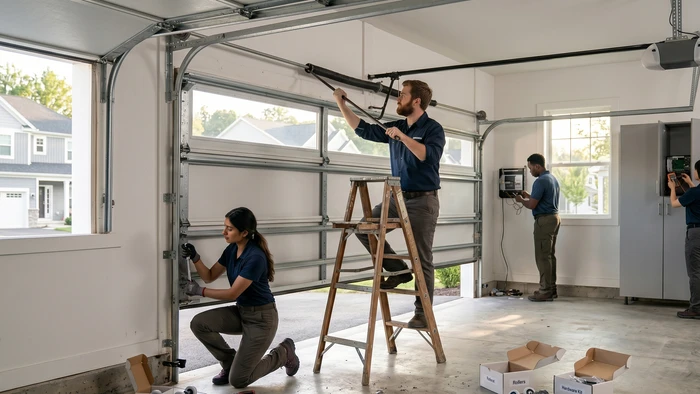
Customer called me last spring. Spring broke on a 14-year-old door. She wanted to know if she should just replace the whole thing. I told her honestly - it depended on a few things I needed to see first.
When I got there, the springs were original to the door. Rollers were cracked. One panel had a dent from a car incident years back. The opener was 13 years old and running slow. The bottom seal was gone. None of these things individually would justify replacement. All of them together on a 14-year-old door told a different story.
The answer to repair vs replace is never just the current repair cost. It's always about the whole system and where everything is in its life cycle. Here's the framework for making that call correctly.
The repair cost percentage rule
The most useful starting point: if the current repair costs more than 50% of what a new door would cost installed, lean toward replacement.
This isn't a hard rule but it's a good filter. A spring replacement on a 3-year-old door in excellent condition - repair it without question. A $600 cable and roller repair on a 13-year-old door with faded panels, worn springs, and a struggling opener - the math looks different. You're spending $600 on a system that has another $800-1,000 in deferred repairs developing.
Get a replacement quote alongside any significant repair quote on an older door. Not to talk yourself into replacement but to have the actual numbers for comparison. Without both numbers, you're making a half-informed decision.
New doors installed in 2026 run $800-1,500 for a standard single car door, $1,200-2,500 for a standard double car door depending on material and insulation. Full breakdown in our how much does a new garage door cost guide. Our garage door repair cost 2026 guide has the real cost ranges for individual repairs so you can build the comparison.
The door age factor - where it fits in its lifecycle
A garage door has roughly a 20-25 year lifespan with proper maintenance. A well-maintained door at year 8 still has most of its life ahead. A neglected door at year 14 may be at end of useful life even if nothing catastrophic has happened yet.
Age alone doesn't determine the decision but it sets the context. Here's a rough framework:
Under 8 years old - repair almost everything except truly catastrophic structural damage. The door has significant life ahead and repairs make sense economically.
8-15 years old - the middle zone where the decision requires judgment. A single-component failure on an otherwise well-maintained door - repair it. Multiple failing components, visible cosmetic decline, opener also aging - run the numbers seriously and compare against replacement.
15+ years old - the calculus tips toward replacement for anything major. Springs, cables, opener all approaching end-of-life simultaneously. Repairs at this stage buy uncertain time on a system that will have another failure soon.
The age of the opener matters too. If the door is 14 years old and the opener is also original - both are approaching end of useful life together. Replacing the door and keeping a 14-year-old opener means the next service call is for the opener in 2 years. Replacing both at the same time eliminates that conversation.
Sequential failures - the pattern that means replacement
The most diagnostic pattern for replacement is multiple components failing in a short window. Spring breaks in October. Cable gets repaired in January. Rollers need replacing in April. Opener struggling by summer.
Each individual repair might be justifiable on its own. The pattern is telling you something. When a door starts requiring attention every few months across different components - that's a system reaching end of life across the board. You're not fixing problems; you're chasing them one at a time while spending steadily toward replacement anyway.
When repairs hit this pattern - add them up. Spring repair $200, cable $150, rollers $130 - you've spent $480 in 8 months on a 15-year-old door. Replacement was available for $1,200. The financial case is closing fast.
What repairs genuinely make economic sense to do
Not every repair on an older door is throwing money away. Some repairs have clear economic logic regardless of door age.
Springs on a door that's otherwise in good condition. If the door is solid - panels intact, rollers serviceable, opener running fine - a spring replacement at $150-300 extends a good system. This is the right repair at the right time.
Sensors and electronic components on a newer door. Sensor replacement at $40-80, wall button at $15-30 - these are cheap fixes that restore full function. Never a replacement trigger.
Bottom seal. $75-150 installed. If the door is in reasonable shape otherwise, replacing a failed seal makes sense as regular maintenance. It's not a sign of system decline.
Rollers on a door under 10 years old. $130-250 for a full set professionally installed. Rollers are a maintenance item. Replacing them on a younger door is normal upkeep.
What repairs should trigger a replacement conversation
Structural panel damage. Crumpled panels, significant bending, dents that affect door travel - combined with an older door. Panel replacement may cost $400-600 for matching panels on an older door. If matching panels aren't available, you're replacing all panels or accepting a non-matching patch. At that cost and difficulty on an older door, replacement often wins.
Opener failure on a door also approaching end of life. Opener replacement at $300-450. If the door also needs springs and has visible wear - you're about to put $600-700 into a 14-year-old door. Replacement of the whole system at $1,500-2,000 gives you 20 years of reliability with a warranty.
Multiple simultaneous failures. The sequential failure pattern described above - when the list is long and the door is old, stop doing individual repairs and do the math.
The case for repair that people don't make often enough
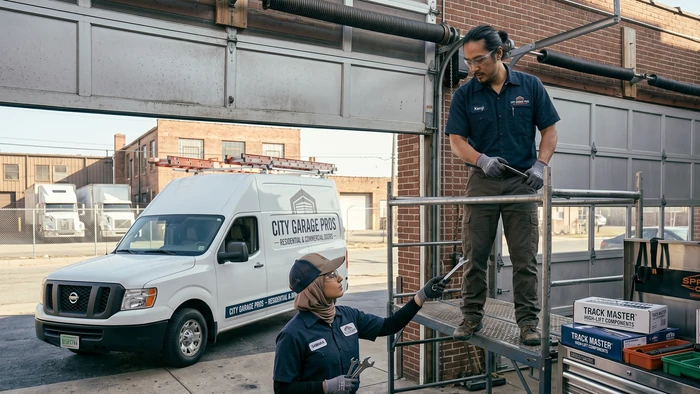
A well-maintained door in good structural condition with one failed component absolutely should be repaired. The replacement-is-always-better bias is wrong for younger doors.
A 6-year-old door with broken springs doesn't need replacement. It needs new springs. A 9-year-old door with a snapped cable doesn't need replacement. It needs cables.
The error on the other side is letting a technician talk you into replacement when a repair is clearly the right answer. A spring breaking on a 6-year-old door with intact panels and a working opener - that's a $200 repair. Anyone suggesting replacement on that scenario isn't giving you good advice.
Our signs your spring is about to break guide helps you understand where in its lifecycle a spring actually is. The why replace both springs guide covers the paired replacement logic that's legitimate advice rather than upselling.
The complete system assessment - what a tech should actually look at
When making the repair vs replace call, a tech should be assessing more than the presenting problem. A complete assessment covers:
Spring condition - both springs, tension test, visual condition of coils. Cable condition - fraying, drum seating, bottom bracket hardware. Roller condition - bearing integrity, nylon cracks, wobble. Panel condition - structural integrity, cosmetic damage, rust. Track condition - alignment, bracket tightness, any deformation. Opener age and operation - speed, sound, battery backup if applicable. Seal and weatherstrip condition. Balance test result - the single most informative test.
A tech who diagnoses a broken spring, replaces it, and leaves without looking at the rest of the system has done half the job. The repair vs replace question requires seeing the whole picture.
If you haven't had a professional tune-up recently and a repair is needed - ask for a full assessment alongside the repair. Our garage door tune-up cost guide covers what a complete assessment includes. That information is what makes the repair vs replace decision a real decision rather than a guess.
One more consideration - energy efficiency and features
A 15-year-old non-insulated door on an attached garage being replaced with a modern insulated door at R-13 isn't just replacing the door - it's meaningfully changing the thermal performance of the home. Adjacent rooms that were cold in winter become noticeably warmer. The incremental energy savings over 20 years are real.
A 15-year-old opener being replaced with a smart opener that has battery backup and myQ connectivity - you're gaining features that didn't exist when the original was installed.
Neither of these arguments makes replacement the right call when repair is clearly appropriate. But when the numbers are close - when the repair cost is 40-50% of replacement - the feature and efficiency improvements of a new system can tip the balance.
GarageDoorRepairz - honest assessment of repair vs replace for your specific door. We'll tell you what we see and give you both numbers. Give us a call.